
Freight Brokerage, Asset-Light, Asset-Based: How to Know When to Use What
Shippers sometimes treat freight brokerage, asset-light transportation, and asset-based transportation as competing models. However, each tool is suited to a different transportation problem.
A manufacturer may need dedicated capacity on a predictable lane, flexible coverage for volatile demand, or access to multiple carriers when its normal network is disrupted. The right model depends on the freight, lane, service requirements, and risk tolerance.
That distinction is increasingly important as transportation networks become more complex. A company can have strong contracted carrier relationships and still need backup capacity. It can have an asset-based transportation provider and still benefit from freight brokerage. Or an asset-light provider can fill geographic or equipment gaps that its own network cannot cover.
The best transportation strategy matches capacity, control, flexibility, and service requirements to the freight.
What Is Freight Brokerage?
In freight brokerage, a licensed broker connects shippers with carriers that have available capacity. Without its own assets, the broker acts as an intermediary, using its carrier network to find transportation that matches the shipment’s requirements.
A freight broker typically handles:
- Finding and vetting carrier capacity
- Negotiating transportation rates
- Matching freight with the appropriate equipment
- Tendering loads
- Tracking shipments
- Managing communication
- Handling exceptions and disruptions
- Providing documentation and billing support
The primary advantage of freight brokerage is flexibility. A shipper doesn’t need to maintain equipment or establish direct carrier relationships in every market it serves. When a shipment falls outside its normal transportation plan, a broker can search its network for available capacity.
That makes freight brokerage particularly useful for irregular shipments, inconsistent lanes, seasonal surges, emergency coverage, specialized equipment, and overflow when primary carriers cannot accept freight.
But freight brokerage isn’t synonymous with transactional spot market freight. A sophisticated brokerage operation can manage recurring contracted freight and become an extension of a shipper’s transportation team. The broker’s value comes from knowing the carrier market, managing capacity, and handling the day-to-day details.
What Is Asset-Based Transportation?
An asset-based carrier owns and operates the trucks and trailers. The fundamental difference from freight brokerage is control. Instead of sourcing a carrier for each shipment, an asset-based transportation provider has its own equipment and drivers.
Potential advantages include:
- Greater control over capacity
- Direct control over drivers and equipment
- More predictable service on dedicated lanes
- Greater visibility into operations
- Ability to establish dedicated transportation
- Less dependence on the open carrier market
Asset-based transportation is generally strongest when freight has consistent volume, predictable lanes, and regular schedules. Consider a manufacturer shipping roughly the same daily volume from a plant to several distribution centers. Dedicated asset-based capacity provides consistency versus sourcing every shipment independently.
The same logic applies when transportation failures have consequences beyond the freight bill. For a manufacturer operating just-in-time (JIT) production, a missed pickup disrupts an entire production schedule. Dedicated capacity helps reduce that risk by giving the shipper greater control over the transportation operation.
What Does Asset-Light Transportation Mean?
In asset-light transportation, a provider doesn’t own enough equipment to perform all or most of the transportation it manages, instead relying on a network of carriers and transportation partners.
Depending on the provider, asset-light transportation can resemble a large-scale freight brokerage operation. But asset-light providers may combine external capacity with their own transportation management, technology, warehousing, or other logistics capabilities.
Asset-light transportation offers greater carrier choice, geographic flexibility, the ability to scale capacity, access to specialized equipment, and broader lane coverage.
But a large carrier network doesn’t automatically produce better transportation. The provider’s value depends on how well it manages that network. Carrier vetting, pricing, routing, tracking, exception management, and customer communication determine whether access to more carriers actually translates into better service.
Freight Brokerage vs. Asset-Based Transportation
The difference becomes clearer when looking at the operational characteristics of each model:
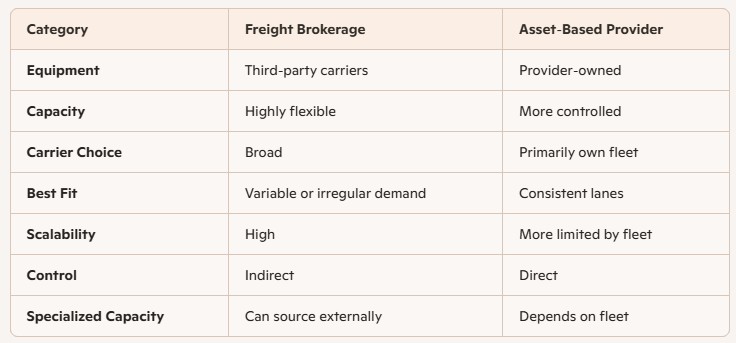
Neither model is inherently better. A shipper with predictable, high-volume dedicated freight may benefit from asset-based capacity, while a shipper facing volatile demand may benefit from freight brokerage. Many companies need both.
When Does Freight Brokerage Make Sense?
Freight brokerage makes sense when flexibility is more important than dedicated capacity. For example, it can be valuable when a shipper:
Has unpredictable demand: Volume fluctuation doesn’t justify dedicated equipment on every lane.
Operates across a broad geographic footprint: A broker can source capacity across markets where the shipper doesn’t have established carrier relationships.
Has a primary carrier reject a tender: Brokerage provides backup capacity when contracted transportation isn’t available.
Needs specialized equipment: A broker can search a broader carrier pool for equipment that may not be available within the shipper’s normal network.
Is entering a new lane: Freight brokerage can establish transportation coverage before permanent capacity is justified.
Experiences a disruption: A broad carrier network provides alternatives when normal transportation plans fail.
That flexibility becomes particularly valuable when market conditions change quickly. Capacity availability, rates and carrier participation can shift, so even a shipper with a well-developed contracted network may need access to additional carriers.
When Does Asset-Based Transportation Make Sense?
Asset-based transportation becomes attractive when consistency and control matter more than maximum flexibility. Potential applications include:
- High-volume recurring lanes
- Dedicated routes
- Time-sensitive manufacturing replenishment
- Just-in-time production
- Regular plant-to-distribution center moves
- Freight requiring consistent equipment or handling
- Transportation programs in which service failures have significant operational consequences
The economics should be evaluated across the entire operation rather than against the lowest available truck rate. Dedicated capacity may carry a different transportation cost, but it can potentially reduce missed appointments, production disruptions, expedited freight costs, shipment variability, and administrative work.
Instead of focusing on a “cheapest truck” approach, consider which transportation model produces the required service at the lowest total cost and operational risk.
Why the Best Answer May Be a Hybrid
For many sophisticated transportation networks, the answer isn’t an “either/or” of freight brokerage or asset-based transportation. Think of transportation capacity as a portfolio.
Asset-based capacity for the core: Use owned or dedicated capacity for predictable, high-volume lanes where consistency matters.
Freight brokerage for the variable: Use a broader carrier network for overflow, seasonal volume, irregular shipments, and lanes that don’t justify dedicated equipment.
Asset-light capacity for the gaps: Use external transportation partners where geographic coverage or equipment requirements exceed the asset network.
For example, a manufacturer might use dedicated trucks for daily plant-to-DC shipments, freight brokerage for inbound suppliers and spot capacity during seasonal peaks. This creates a capacity portfolio rather than forcing every shipment into the same transportation model.
Shippers can separate their core transportation needs from variable requirements. Predictable freight gets the capacity strategy designed for consistency; unpredictable freight gets the flexibility to respond to changing conditions.
How TCG Combines Transportation Models
TCG’s value proposition is all about matching the transportation model to freight requirements. We combine asset-based dedicated trucking with freight brokerage as well as intermodal, warehousing and distribution, transportation management, and network knowledge.
Having both asset-based and freight brokerage capabilities gives TCG a broader view of the transportation market. For example, if a shipment fits the asset network, that capacity can be used; if it doesn’t, TCG can access external carrier capacity. Or if inventory needs to be positioned closer to customers, our warehousing services become part of the solution.
The objective is to solve the transportation problem rather than sell a particular mode or service. That distinction matters because a transportation provider shouldn’t be trying to make every shipment fit the same operating model.
The Questions to Ask Before Choosing a Transportation Model
Before deciding how a lane should be covered, shippers should ask:
- How predictable is shipment volume?
- How consistent are the lanes?
- How critical is delivery timing?
- What happens if capacity isn’t available?
- Does the freight require specialized equipment?
- How much geographic flexibility is needed?
- Are seasonal or surge volumes common?
- Would dedicated capacity eliminate recurring operational problems?
- Where does the shipper need backup capacity?
- Can one provider manage multiple transportation models?
The answers will reveal how different parts of the same network require different approaches.
A shipper may discover that its most predictable lanes warrant dedicated capacity while its less predictable freight is better suited to freight brokerage. Another company may find that intermodal makes sense for certain long-haul lanes while truckload remains the better option for time-sensitive shipments. The objective is to determine the right model for each part of the network.
Don’t Choose One Transportation Model; Build the Right Mix.
Freight brokerage, asset-light transportation, and asset-based transportation aren’t mutually exclusive strategies. Each addresses a different capacity problem:
- Freight brokerage provides flexibility.
- Asset-light transportation provides network breadth.
- Asset-based transportation provides control and dedicated capacity.
The strongest transportation strategy uses each where it makes operational and economic sense.
TCG helps shippers build that mix through asset-based dedicated trucking, freight brokerage, intermodal, and warehousing capabilities. Rather than forcing every shipment into one model, TCG can evaluate the lane, freight characteristics, service requirements, and capacity needs to determine the appropriate approach.
For manufacturers and distributors, that means transportation can be designed around the freight itself, not around the limitations of a single transportation model. Ready to build a more flexible transportation strategy? Contact TCG today to evaluate the right mix of capacity, modes and service models for your network.
.jpg)