
When Does a Company Actually Need Dedicated Trucking?
If a shipment is important, it can be tempting to assume it requires dedicated trucking. Put a truck on the lane, assign a driver, control the schedule, and eliminate the uncertainty of finding capacity shipment by shipment.
But dedicated capacity comes with a trade-off. A shipper is committing to transportation capacity and an operating structure. The question should always be, “Does our freight profile justify dedicated capacity?”
Dedicated trucking delivers the greatest value when predictable freight, demanding service requirements, and the consequences of transportation failure justify the commitment. For variable freight, brokerage, common carrier capacity, or other flexible transportation options may make more sense.
What Is Dedicated Trucking?
Dedicated trucking is a transportation arrangement in which trucks, drivers, or capacity are committed to serving one shipper or transportation program on a recurring basis. With a dedicated program, capacity is planned around the shipper’s network. Equipment and drivers may follow recurring routes or schedules, and the program can be structured around particular plants, distribution centers, customers, or lanes.
Dedicated trucking can take several forms, including:
- Plant-to-DC routes
- Multi-stop distribution
- Shuttle operations
- Supplier-to-plant movements
- Regional delivery routes
- A dedicated fleet serving a specific customer
Importantly, dedicated does not necessarily mean a truck is physically assigned to one shipment at all times. It’s about committed capacity supported by a defined operating plan.
The First Question: How Predictable Is Your Freight?
Predictability is one of the strongest indicators that dedicated trucking may be appropriate. Consider a shipper moving the same number of loads over the same lanes every week. Pickup and delivery schedules are consistent, and equipment requirements rarely change. That’s the kind of freight around which a dedicated program can be built efficiently.
The opposite characteristics can be warning signs. Large swings in weekly volume, extreme seasonality, one-off lanes, frequently changing origins and destinations, or freight that can be consolidated or routed differently can make committed capacity harder to utilize efficiently. The more predictable the freight, the easier it is to build an efficient dedicated transportation program.
What Happens When the Truck Doesn’t Show Up?
The dedicated-versus-flexible decision shouldn’t stop at the transportation rate. It should also consider the cost of transportation failure.
What happens when a truck misses a pickup? Does a production line stop? Does the shipper have to pay for an expedite? Does a customer miss a delivery appointment? Are there financial penalties? Does a late inbound shipment leave employees or equipment waiting?
For a manufacturer operating with lean inventory, even a single transportation failure can create costs far beyond the freight invoice.
Dedicated trucking can be particularly valuable when:
- JIT or lean manufacturing leaves little room for transportation variability.
- Plants depend on scheduled inbound replenishment.
- Customers require highly consistent delivery windows.
- Missed appointments have significant downstream consequences.
- Transportation disruptions create labor, production, or scheduling costs.
In these situations, the economic case for dedicated trucking is less about securing the absolute lowest transportation rate and more about reducing the cost of transportation failure.
Does Your Network Have a Core That Deserves Dedicated Capacity?
Look for the core freight that happens frequently enough and matters enough to justify committed capacity. That could include a manufacturer’s highest-volume lanes, the routes with recurring capacity problems, or shipments that are especially important to production or customer service.
Consider a manufacturer moving 8-10 truckloads every day from plant A to DC B. This creates a predictable transportation requirement that may justify dedicated capacity. This company’s irregular supplier shipments across the country are a different story, which are better served through brokerage or other flexible capacity.
This creates a capacity portfolio rather than an all-or-nothing decision. Dedicated trucking can cover the predictable core, while brokerage and common-carrier capacity can handle variable freight.
Intermodal can provide another option where economics and transit requirements support a modal shift. The goal is to match the capacity model to the freight.
Dedicated Trucking vs. Flexible Capacity
Dedicated trucking isn’t automatically superior to flexible capacity. Each solves a different problem.
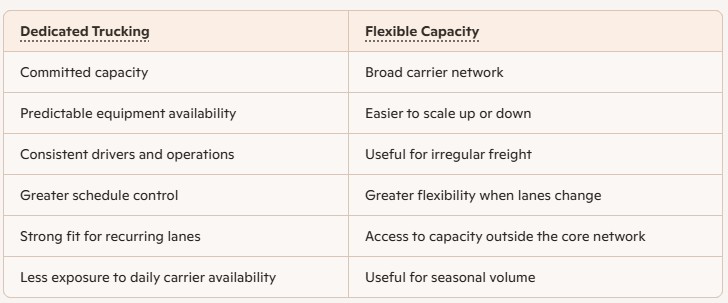
The trade-off is straightforward: dedicated capacity sacrifices some flexibility in exchange for consistency. Flexible capacity sacrifices some control in exchange for broader market access.
What Does Dedicated Trucking Actually Cost?
A shipper evaluating dedicated trucking shouldn’t compare a dedicated rate against a single spot quote and stop there. The more useful calculation considers total transportation cost, including:
- Linehaul
- Fuel
- Empty miles
- Driver utilization
- Detention
- Accessorials
- Expedite costs
- Missed appointments
- Production disruptions
- Administrative time
Dedicated programs can create efficiencies through planned routes, better equipment utilization, consistent schedules, and reduced tendering activity. They can also reduce day-to-day variability in transportation performance.
But committed capacity can become expensive if equipment sits idle. That’s why one of the most important questions for a shipper is: How much utilization can we realistically provide?
A truck that is moving efficiently across a recurring network can create considerable value. A truck sitting unused because weekly freight volumes fluctuate dramatically is a different proposition.
A Dedicated Trucking Decision Checklist
Before approaching a provider about dedicated trucking, shippers should evaluate their own freight. Consider dedicated capacity if you can answer “yes” to most of these questions:
- Do we ship the same lanes repeatedly?
- Is weekly or monthly volume relatively predictable?
- Do we need highly consistent capacity?
- Would a missed pickup or delivery create significant downstream costs?
- Do we have recurring schedules that support dedicated routes?
- Can we keep equipment reasonably utilized?
- Do we need consistent equipment or specialized handling?
- Are we spending heavily on expedites or emergency capacity?
- Do we experience recurring carrier or service failures?
- Would consistent drivers or operating procedures improve performance?
- Could consolidating recurring moves into one program improve utilization?
If most answers are “no,” flexible truckload capacity or brokerage may be more appropriate. A hybrid approach may be the better answer.
When Dedicated Trucking Isn’t the Answer
There are plenty of situations where adding dedicated trucks doesn’t solve the underlying problem. Seasonal businesses with extreme volume swings may struggle to keep committed equipment utilized. Highly fragmented networks may not generate enough recurring volume on individual lanes. Freight that frequently changes origin or destination may require the flexibility of a broader carrier network.
Sometimes the primary problem isn’t truck availability at all. It may be a network design issue that could be addressed through shipment consolidation, inventory repositioning, different distribution points, or a modal change. In those cases, adding dedicated trucks could lock an inefficient network into a more expensive transportation structure.
How TCG Helps Determine the Right Capacity Model
The right transportation strategy starts with understanding the freight rather than automatically recommending a particular service.
TCG brings together asset-based dedicated trucking, freight brokerage, warehousing and distribution, owned capacity plus brokerage, intermodal, and cross-border transportation capabilities. This broad portfolio allows shippers to consider committed and flexible capacity as parts of the same transportation strategy.
For example, dedicated capacity can cover predictable, high-volume lanes while brokerage provides flexibility for irregular shipments. Intermodal can become an option where transit requirements and economics allow a modal shift. Warehousing can help reposition inventory and potentially change the transportation requirements altogether.
Looking at these options together can help identify where dedicated capacity creates value, and where it doesn’t. The evaluation can include lane history, shipment frequency, volume, service requirements, equipment needs, and the potential cost of transportation failures.
Ask Which Freight Needs Dedicated Capacity
Dedicated trucking is a tool, not a default transportation strategy. The objective is to put the right capacity behind each piece of freight. The strongest case for dedicated trucking typically exists where volume is predictable, lanes repeat, capacity is operationally important, and service failures are expensive. Flexible transportation remains valuable for freight that is seasonal, irregular, or difficult to forecast. For many shippers, the best answer is a combination of both.
TCG helps shippers determine which freight deserves committed capacity, where flexible coverage makes more sense, and how different transportation options can work together. Contact TCG today to evaluate the right capacity strategy for your network.
.jpg)